
The entire tax landscape is uncertain given the Biden administration’s tax proposals and the 2024 elections. The primary reason for the uncertainty relates back to the Tax Cuts and Jobs Act (TCJA) which made sweeping changes to the tax provisions applicable to both individuals and businesses. While most of the TCJA business tax provisions were made permanent, many of the changes affecting individuals are set to expire in 2026 and revert back to the law as it existed prior to 2018.
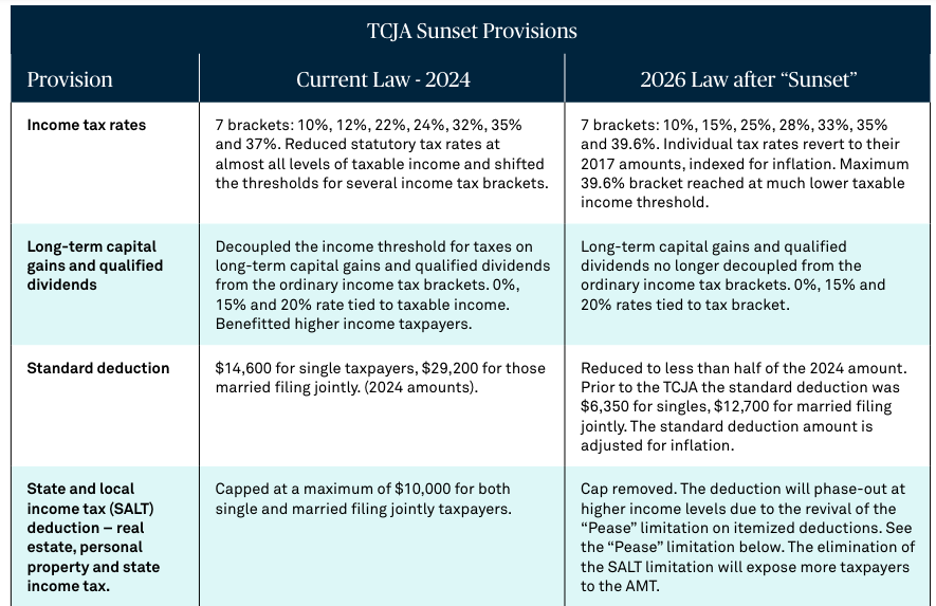
Many individuals may be surprised by increased tax liabilities resulting from the sunset provision. Here we will discuss the two big categories of changes to be aware of – various income tax changes and the decrease in the estate, gift and generation skipping exemption. The chart below summarizes the law as it exists in 2024 and, assuming Congress does not intervene in the meantime, the changes that will have the greatest impact on individuals in 2026. Now is the time to think about the implications of the expiring tax cuts and begin reviewing your estate and income tax planning.

Individual Income Tax–Changes in Income Tax Rates.
Current law has seven income tax brackets. The same is true for the post-2025 brackets. However, the brackets and the income thresholds for each bracket will change. For example, the maximum individual income tax bracket for ordinary income will increase from 37% to 39.6%. Also, taxpayers will reach the maximum 39.6% bracket at a lower income threshold, thereby increasing income taxes paid. Taxpayers may want to consider accelerating income into tax years 2024 to 2025 to avoid the anticipated increase in income taxes. In addition, deferring deductions until post-2025 may result in additional income tax savings. Those with a traditional IRA may want to consider converting to a Roth IRA, thereby ideally paying income taxes on the conversion at a lower rate than would be the case if the conversion is done after 2025. Funds in a Roth IRA continue growing tax-free. Roth IRAs generally have no required minimum distributions and withdrawals are tax exempt once the owner reaches age 59½ and the account is at least five years old.
Long-Term Capital Gains and Qualified Dividends. While the favorable 0%, 15% and 20% rate on long-term capital gains and qualified dividend has not changed, the income thresholds for reaching those rates are scheduled to change. Although the tax difference may not be substantial, taxpayers should review the income threshold for each rate to avoid inadvertently having long-term capital gains and qualified dividends taxed at an unanticipated higher rate. It may be advisable to harvest capital gains by selling appreciated securities prior to the expiration of the TCJA provisions in anticipation of higher tax rates. Since the wash sale rules only apply to losses, not gains, you can maintain your position in the securities by repurchasing the same securities, resulting in an increased cost basis to minimize future gains. Planning like this should be thoughtfully discussed with a tax advisor to determine an appropriate strategy/best tax outcome given individual circumstances.
Standard Deduction. The TCJA nearly doubled the standard deduction resulting in a vast reduction in the number of taxpayers who itemized their deductions. Beginning in 2026, the standard deduction will be reduced by approximately half, meaning many more people will again be itemizing their deductions as opposed to taking the standard deduction.
State and Local Income Tax (SALT) Limitation. The $10,000 cap on state and local income taxes will disappear after 2025, allowing larger itemized deductions for state income and property taxes. However, the relief comes with a hidden cost. Larger state income and property taxes means a greater chance taxpayers claiming the deduction may be subject to the dreaded alternative minimum tax (AMT). Exposure to the AMT is exacerbated by the decrease in the AMT exemption and the reduction of the income level at which the AMT exemption begins to phase out. Being subject to the AMT will eliminate the benefit of a state income and property tax deduction. Even if not subject to the AMT, the revival of the Pease limitation (discussed below) may reduce the benefit of the state income and property tax deduction.
Mortgage Interest Deduction. There is good news for home buyers. The amount of interest that qualifies as an itemized deduction will increase after 2025. The debt limit for acquisition indebtedness (debt incurred to buy, construct or substantially improve a primary or secondary residence) for deductible interest will increase from $750,000 to $1 million. In addition, interest on up to $100,000 of home equity debt will again be deductible as an itemized deduction.
Miscellaneous Itemized Deductions. Beginning in 2025, miscellaneous itemized deductions, such as investment management fees and tax preparation fees, will again be deductible. However, those deductions will only be allowed to the extent the itemized deductions (excluding some itemized deductions such as investment interest expenses) exceed two percent of your adjusted gross income (AGI). Thus, the good news is miscellaneous itemized deduction will again be deductible. The bad news is the so-called two-percent floor, also returns.
[2] Pease Limitation on Itemized Deductions. The Pease limitation is restored, throwing some cold water on the deductibility of itemized deductions for high income taxpayers. The limitation reduces itemized deductions by three percent of AGI in excess of an annually inflation adjusted threshold. This is often referred to as the “three percent haircut” on itemized deductions. The reduction is capped at a maximum of 80% of a taxpayer’s itemized deductions, so at least some amount of itemized deductions are spared. This limitation will affect high-income taxpayers almost exclusively.
Alternative Minimum Tax (AMT). The sunset of the TCJA provision will force more taxpayers to pay the AMT. The AMT exemption is drastically reduced as is the income threshold for the phase out of the reduced AMT exemption. Large capital gains and the increased deductibility of state income and property taxes may subject many to the dreaded AMT.
Personal and Dependent Exemptions. Beginning in 2026, the personal and dependency exemption will again be allowed. However, high-income taxpayers will most likely not enjoy the benefit of these deductions as the deduction will be phased out for higher income taxpayers.
Income Tax Charitable Deduction. The limit on cash gifts to a public charity will be reduced from 60% of AGI1 to 50% of AGI, the limit that existed prior to the TCJA. Any excess over the 50% of AGI limit will continue to enjoy a five-year carryover.
Casualty Losses. Currently, casualty losses are generally deductible only if the President declares it a federal disaster. Beginning in 2026, casualty losses will again be deductible regardless of whether the President declares it a federal disaster.
Business Provisions Section 199A Qualified Business Income Deduction. The 20% deduction (subject to limitations not discussed here) available to pass-through entities will be eliminated beginning in 2026. While the 21% corporate income tax rate is permanent (absent subsequent Congressional action), in some cases partnerships, S-Corporations and LLCs will be subjected to a higher rate of tax than their corporation counterparts. Taxpayers must weigh the 21% corporate tax rate along with the double taxation of corporate income against the higher tax rate applicable to pass-through entities in choosing the form of business entity.
Estate, Gift and Generation Skipping Tax Exemption. Much has been said and written about the pending reduction of the estate, gift and generation skipping tax exemption. The current exemption, which is indexed annually for inflation, is $13,610,000 per person in 2024. Beginning in 2026, the exemption will be $5 million increased for post-2011 inflation, which is projected to be about $7.2 million. Taxpayers should consider using part or all of the increased exemption before it is scheduled to be reduced. Based on IRS guidance and conventional wisdom, use of the increased exemption will generally be respected by the IRS, even if the donor’s death occurs after the exemption has been reduced, i.e., there will be no[3] clawback.”
Planning considerations for using the increased exemption include outright gifts, gifts to spousal lifetime access trust (SLATs), gifts to irrevocable grantor trusts as well as gifts to charitable split interest trusts (charitable lead trusts and/or charitable remainder trusts). To avoid the many traps for the unwary, advanced planning should include your team of advisors. For example, spousal split-gifts in an amount less than the increased exemption are best avoided – instead have one spouse use their exemption so that after the reduction of the exemption, the other spouse has their exemption remaining. For spouses that pass during the next couple of years, portability elections made during the increased exemption period will not be affected by the decrease in the exemption. The full exemption amount transferred to a surviving spouse will be available for their estate after 2025.
Conclusion
Taxpayers should start thinking about the pending sunset of the changes made by the TCJA. Many will discover that their income taxes will increase. Additionally, others may be subject to increased estate taxes. Planning now in anticipation of the sunset may enable taxpayers to avoid having to pay additional tax to the government. The one big caveat – there could be new tax legislation which may extend the current provisions, enactment of overriding tax provisions or Congress does nothing at all. As always, we stand ready to assist clients in wading through the changes and how those changes will affect your estate and investment planning.
SOURCE: BNY Mellon Wealth